How to Price Your Freelance Services: The Complete 2026 Guide
Learn exactly how to price your freelance services — from calculating your minimum viable rate to choosing the right pricing model, handling platform fees, and knowing when to raise your rates.
Put this guide into action
Use the free Freelancer Rate Calculator while you read. No account required, and your inputs stay private.
You spent three hours writing a proposal. You quoted $800. The client accepted without blinking.
That pause before they said yes? That's the sound of money you left on the table.
Pricing is the single most consequential skill in freelancing — and the one most freelancers handle with the least strategy. They guess. They compare themselves to a random listing on Upwork. They charge what feels "safe" rather than what reflects the value they actually deliver. The result is a business that's always busy but never quite profitable.
This guide cuts through that. By the end, you'll know exactly how to calculate your minimum viable rate, which pricing model fits which situation, how platform fees erode your earnings, and when it's time to stop playing it safe and charge more.
Why Most Freelancers Underprice Their Work
Before we get to numbers, it's worth understanding why underpricing is so common. It comes down to three deeply ingrained habits:
The employee comparison trap. Most freelancers came from employment. They anchor their rates to their old salary divided by 2,080 hours (the standard work year) and call it a day. The problem: employees don't pay their own taxes, health insurance, retirement, equipment, software, or time spent on unpaid admin work. A $60/hr freelance rate is worth far less than a $60/hr salary.
Fear of losing the client. When you're new or hungry, every potential client feels like one you can't afford to lose. So you lower your rate to close the deal. This works in the short term and creates a slow trap: a roster of price-sensitive clients who'll leave the moment someone cheaper appears.
Pricing based on cost, not value. Most freelancers calculate what they need to survive and charge that. The smarter question is: what's this worth to the client? A landing page that converts at 4% instead of 1% can be worth six figures in additional revenue to a business. Charging $1,500 for it because "it only took me 10 hours" is leaving money on the table.
The antidote to all three is a clear, defensible pricing structure — one that starts with your real costs and scales up toward the value you deliver.
Step 1: Calculate Your Minimum Viable Rate
Your minimum viable rate (MVR) is the floor below which you cannot work without losing money. Everything above it is profit. You need to know this number before you quote a single project.
The formula is straightforward:
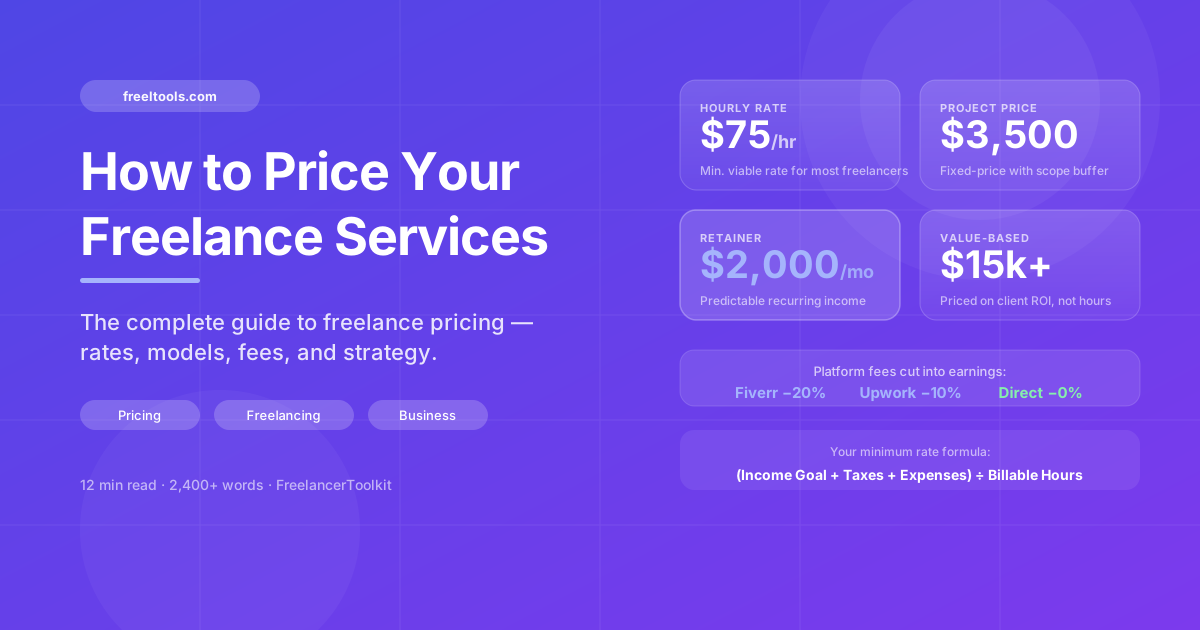
MVR = (Annual Income Goal + Annual Taxes + Annual Expenses) ÷ Billable Hours per Year
Let's walk through each variable.
Annual income goal. This is your take-home target — what you want to actually net after everything. Be honest. Factor in rent, food, savings, travel, retirement contributions, and a small buffer for the unexpected.
Annual taxes. As a self-employed freelancer in the US, you'll pay self-employment tax (15.3% on net earnings) plus federal and state income tax. A conservative estimate for most US freelancers is 28–32% of gross income. If you're in a high-income-tax state, use 35%.
Annual expenses. Add up every cost of running your business: software subscriptions, equipment depreciation, professional development, accountant fees, coworking space, internet, professional insurance, and anything else you spend to do your job.
Billable hours. This is where most freelancers make a critical error. They assume they'll bill 40 hours a week, 52 weeks a year. In reality, experienced freelancers bill 15–25 hours out of a 40-hour week. The rest goes to sales, admin, invoicing, networking, professional development, and simply the reality that not every hour can be sold. A realistic annual billable hours number is between 1,000 and 1,500 for a solo freelancer.
Example: Say you want $80,000 take-home, estimate 30% in taxes ($34,286 gross-up), have $8,000 in annual expenses, and realistically bill 1,200 hours per year.
- Annual gross needed: $80,000 ÷ 0.70 = $114,286
- Total with expenses: $114,286 + $8,000 = $122,286
- MVR: $122,286 ÷ 1,200 = $101.90/hr
That's your floor. You should never take work below $102/hr — not for a "quick" project, not for a "good client relationship," not for "exposure."
Use our Freelancer Rate Calculator to run your own numbers in under two minutes. It handles the tax gross-up math automatically.
Step 2: Choose the Right Pricing Model
Knowing your MVR gives you a floor. Your pricing model determines how you package and present that rate to clients. There are four main models, and the best freelancers use all four depending on the situation.
Hourly Rate Pricing
Best for: Ongoing work, unclear scopes, consulting, or any project where requirements may change significantly.
Hourly pricing is the simplest and safest model when you don't know what you're getting into. You track time, you invoice time, the client pays for what you deliver. There's no risk of scope creep bleeding into your earnings.
The downside: it caps your income at time. Once you're fully booked, there's no way to earn more without working more hours. And clients sometimes push back on the lack of predictability.
When billing hourly, always quote a range upfront ("this will likely run 8–12 hours") so clients aren't surprised. Track your time meticulously and send weekly summaries for any project running more than two weeks.
Fixed Price / Project-Based Pricing
Best for: Well-defined deliverables, creative projects, development work with clear specifications.
Fixed pricing lets you earn more by working efficiently. If a project is scoped at $3,000 and you complete it in 18 hours instead of 25, your effective hourly rate jumps significantly. The client gets budget certainty; you get an incentive to work smart.
The risk is the reverse: if the project runs over, your effective rate drops — sometimes dramatically. This is why fixed-price work requires careful scoping, a written scope of work, and a clear revision policy.
A practical rule: only offer fixed pricing when you've done similar work at least three times. Your first landing page design should probably be hourly. Your fifteenth can be fixed.
Use our Project Cost Calculator to build your fixed-price quotes the right way — with a scope buffer and revision rounds baked in before you send the number to a client.
Retainer Pricing
Best for: Ongoing relationships, monthly deliverables, content, social media, maintenance, or any predictable repeating work.
A retainer is a monthly agreement where a client pays a fixed fee for a guaranteed number of hours or deliverables. The client gets priority access and budget predictability. You get recurring income you can count on.
Retainers are the closest thing to a salary in freelancing — and they're the foundation of a stable freelance business. If you can convert even two or three clients to monthly retainers, your income becomes significantly more predictable and your need to constantly hunt for new work decreases.
The standard retainer discount is 5–15% off your regular rate. You're trading a slight rate reduction for the guarantee of volume.
Calculate your retainer price →
Value-Based Pricing
Best for: Experienced freelancers, strategic work, projects where you can quantify the client's ROI.
Value-based pricing decouples your rate entirely from hours. Instead of asking "how long will this take?" you ask "what is this worth to the client?" A single email campaign that generates $200,000 in revenue isn't worth $500 because it took four hours to write. It's worth a percentage of the value it creates.
Value-based pricing requires confidence, strong positioning, and the ability to have direct conversations about client outcomes. It's not a beginner move — but it's the ceiling of what's possible when you price strategically.
The shortcut: ask every potential client what the outcome of this project is worth to their business. Their answer tells you exactly how to anchor your price.
Step 3: Account for Platform Fees
If you work through Fiverr, Upwork, Freelancer.com, or similar platforms, the price you set is not the money you take home. Platform fees are significant and must be factored into your rate before you quote.
Here's what each major platform takes from sellers:
| Platform | Seller Fee | You Keep on $1,000 |
|---|---|---|
| Fiverr | 20% | $800 |
| Upwork | 0-15% by contract | $850-$1,000 |
| Freelancer.com | 10% | $900 |
| PeoplePerHour | 20% | $800 |
| Direct client | 0% | $1,000 |
The math is brutal if you don't account for it. On Fiverr, you need to charge $125 to net $100. On Upwork, check the freelancer service fee shown for the contract: at 10%, you need to charge about $111 to net $100; at 15%, you need about $118.
The implication: your platform rate should usually be higher than your direct-client rate to achieve the same net income. If your MVR is $100/hr, the required platform rate depends on the fee shown before you bid.
Use our dedicated calculators to see exactly what you'll net on any order:
- Fiverr Fee Calculator — includes a reverse calculator to find the gig price that hits your target net
- Upwork Fee Calculator — shows net earnings and what to charge for a target take-home
The other implication: direct client relationships are more valuable than most freelancers realize. Cutting out the platform means keeping 100% of every dollar billed. Building a direct client pipeline — even while using platforms for inbound leads — is one of the highest-leverage moves in freelancing.
Step 4: Build Late Payment Protection Into Your Pricing
Here's a part of freelance pricing almost nobody talks about: the cost of not getting paid on time.
Late payments are endemic in freelancing. A 2024 survey by the Freelancers Union found that 71% of freelancers have experienced late payment, and the average freelancer loses over $6,000 per year waiting on overdue invoices. When you're waiting on a $3,000 invoice that's 45 days past due, that money isn't working for you — it's working for the client.
The solution has two parts.
Part one: get a deposit upfront. For any fixed-price project, require 25–50% before you start. This pre-qualifies clients (serious buyers don't balk at reasonable deposits), reduces your exposure, and gives you working capital while the project is in progress. Retainer clients should pay the monthly fee before the month begins, not after.
Part two: include a late fee clause. Put a late fee policy in every contract and on every invoice. The standard is 1.5% per month (18% annually). This doesn't mean you'll charge it on every late invoice — it means you have the contractual right to do so, which is often enough to motivate faster payment.
Use our Late Payment Fee Calculator to calculate exactly what a client owes when an invoice goes overdue. It also generates a ready-to-send email notice you can copy in seconds.
Step 5: Know When to Raise Your Rates
Raising rates is the highest-leverage action available to most freelancers — and the one most consistently delayed. If your rate hasn't changed in 12 months, you've effectively taken a pay cut when adjusted for inflation.
Here are the clearest signals that it's time to raise:
You're fully booked. If you're turning down work or struggling to fit new clients in, demand for your services exceeds supply. That's the textbook condition for a price increase.
Clients accept without negotiating. When the last five clients said yes to your quote immediately and without a single counteroffer, you're below the market. A small percentage of resistance (10–20%) is healthy — it means you're priced at the top of what the market will bear, not well below it.
Your skill set has grown significantly. If you've added certifications, delivered bigger projects, or moved upmarket in the last year, your rate should reflect it. Skills compound; rates should too.
You're attracting price-sensitive clients. If the bulk of your client conversations are about discounts, your price is attracting the wrong clients. Counterintuitively, raising rates often improves client quality because it prices out the buyers who were going to be difficult anyway.
The typical annual rate increase for mid-career freelancers is 10–20%. If you're changing niche or moving to a more specialized market, a 25–50% jump in one move is not unusual. Give existing clients 30–60 days notice, honor current project rates through completion, and use the time to find clients who fit the new rate.
See exactly how much more you'd earn with our Freelance Rate Increase Calculator. Enter your current rate and target increase and it shows your additional annual revenue — plus a copy-paste email you can send to clients.
The Most Common Pricing Mistakes (and How to Fix Them)
Mistake: Charging the same rate for every type of work. Your logo design rate and your brand strategy rate should not be the same. Strategy, consulting, and high-stakes deliverables command higher rates than execution-level work. Develop a tiered rate card that reflects the real differences in value.
Mistake: Giving discounts to land the first project. "Just this once" discounts set an expectation that's almost impossible to reverse. If you offer $1,000 for a project that should be $1,500, the client's baseline becomes $1,000. Future work gets quoted against that anchor. If you want to win a client at a lower rate, do it transparently: offer a limited-time new client rate and document that future work reverts to your standard pricing.
Mistake: Not including buffer in fixed-price quotes. Scope creep is not the exception in freelancing — it's the rule. Every fixed-price project should include a 15–25% scope buffer to absorb the inevitable "while we're at it" requests. This isn't padding; it's realistic scoping.
Mistake: Forgetting non-billable time. Every client relationship involves time you can't invoice: initial calls, revisions debates, invoicing, project management, email threads. Factor in 20–30% non-billable overhead when you quote fixed-price projects. If you don't, you'll discover the true cost when you're three weeks in and unpaid.
Mistake: Treating your rate as permanent. Your rate is a living number. It should increase as your skills grow, your reputation builds, and the market shifts. Review it every six months at minimum. Compare it to what similar freelancers in your niche are charging. Adjust accordingly.
Your Freelance Pricing Checklist
Before you quote your next project, run through this list:
- I know my minimum viable hourly rate (use the Rate Calculator)
- I've chosen the right pricing model for this project (hourly vs fixed vs retainer)
- If billing fixed price, I've added a 15–25% scope buffer
- I've factored in platform fees if working through Upwork, Fiverr, or similar (Fiverr Calculator / Upwork Calculator)
- My proposal includes a payment schedule with a deposit due before work starts
- My contract or invoice includes a late payment fee clause (1.5%/month)
- I've reviewed my rate in the last 6 months and increased it if warranted
The Bottom Line
Pricing is not a fixed feature of your freelance business — it's a strategy you actively manage. The freelancers who build genuinely profitable practices aren't the ones who work the most hours. They're the ones who charge rates that reflect real value, choose pricing models that fit each engagement, protect themselves with deposits and late fee policies, and raise their rates consistently as their experience compounds.
Start with your minimum viable rate. Build upward from there. Use the tools above to do the math quickly and correctly, so the only thing you have to think about is the value you deliver.
Your work is worth more than you're charging for it. The first step is knowing the number — then having the confidence to say it out loud.
Use these free tools to put this guide into action:
- Freelancer Rate Calculator — Calculate your MVR in 2 minutes
- Project Cost Calculator — Build fixed-price quotes with scope buffer
- Fiverr Fee Calculator — See your Fiverr net earnings instantly
- Upwork Fee Calculator — Calculate Upwork take-home on any project
- Rate Increase Calculator — See the revenue impact of raising your rates
- Late Payment Fee Calculator — Calculate overdue interest and generate a client notice
FAQ
What is the best way to price freelance services?
Start with a minimum viable hourly rate, then choose hourly, fixed-price, retainer, or value-based pricing based on scope clarity and client needs.
Should freelancers publish prices?
Publishing starting prices can qualify leads, but custom projects often need a range or proposal after discovery. Choose the approach that matches your sales process.
How do I price fixed freelance projects?
Estimate task hours, multiply by your rate, add expenses and buffer, define revisions, then quote around the outcome and scope rather than raw hours.
How do platform fees affect freelance pricing?
Platform fees reduce take-home pay. Use fee calculators for Fiverr, Upwork, and similar marketplaces before setting the public price or bid.
Free tools for freelancers
Put this advice into action with our free calculators and generators — no login required.